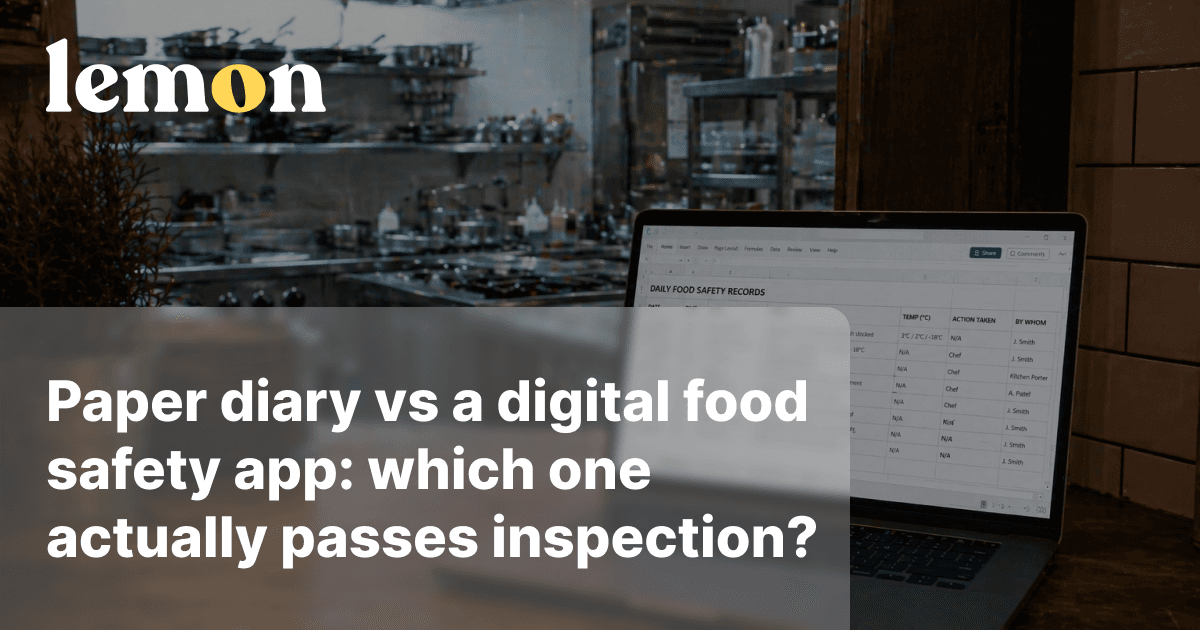
Every UK kitchen falls into one of three camps. There is the paper-diary kitchen, where the records live in a wire-bound A4 book by the walk-in. There is the spreadsheet kitchen, where someone set up an Excel template three years ago and a manager updates it once a week if they remember. And there is the app kitchen, where a phone gets passed around the line and the records appear in someone's email when an inspector asks for them.
This is not an article about which one is “best”. It is an article about which one passes the test the inspector actually applies, which is a narrower and more interesting question.
What paper actually does well
Let us not pretend paper is useless. It is not. A well-run paper diary has real advantages:
- Zero setup cost. A pad, a pen, a clipboard. £4 from a stationer.
- No training curve. Anybody who has worked in a kitchen for a week knows how to write in a diary.
- No technology dependency. No app to crash, no phone to die, no software update to break the workflow on a Friday night.
- Immediate. No login screen between you and the next entry.
- Universally accepted. No EHO has ever refused to look at a paper diary.
For a small operation, especially one with a single owner-operator who does most of the recording themselves, paper is genuinely workable, provided you understand what the UK fridge temperature law actually requires and you keep contemporaneous records. We are not going to pretend it is not.
Where paper falls down
The problems with paper are not visible day to day. They appear in five places, all of which are decisive in an inspection or a defence.
1. Timestamps that are not really timestamps
A paper diary entry has the date you wrote at the top of the page. It does not have the time the reading was actually taken. In practice, kitchens operating on paper end up with one of three patterns:
- Entries written at the moment of the reading. Honest, hard to maintain, the gold standard.
- Entries written at the end of the day, from memory. Still defensible, but starts to look uniform across days.
- Entries written on Friday for the whole week. Visible to an inspector at 50 paces.
The inspector's job, in part, is to sniff out which pattern your diary follows. The same biro, the same pressure on the page, the same handwriting across seven consecutive days, all the same number? They have seen this before.
2. No attribution
Most paper diaries have a single signature at the bottom of the page, or no signature at all. Lemon and other digital systems force a name on every entry, which is what an EHO actually wants (“who took this reading?”). On paper, attribution is nominal at best.
3. Retroactive editing
A paper diary can be quietly amended in pencil, overwritten in Tipp-Ex, or torn out and replaced. This is not speculation, it is something every EHO has seen. The very fact that paper can be edited after the event means an inspector treats every paper record with a degree of scepticism that they do not apply to a timestamped digital one.
4. Six months of records, when?
The single hardest thing to do with a paper diary is produce six months of records on demand. The diary covers two months, or one. The previous diary is in a box in the office. The one before that is in the loft. By the time you have gathered them all, the inspector has already drawn their conclusion.
5. The closing-team problem
The biggest practical failure of paper in a busy kitchen is not any of the above. It is that the diary lives in the office, the chef is in the walk-in, and the closing team is exhausted. The PM check is the one that gets skipped, and on paper, “I will do it tomorrow” turns into “I will fill in three days at once on Friday”.
A phone in your pocket fixes this purely because of where the diary now lives.
Where spreadsheets sit
A quick word on the middle option, because lots of kitchens think they have solved the problem by moving to Excel and they have not.
A spreadsheet retains most of the disadvantages of paper (retroactive editing, optional attribution, no enforced timestamping) and adds new ones: the file gets emailed around in three different versions, formulas break, somebody saves over the master, and on the day of the inspection nobody can find the version that has the fridge readings.
Spreadsheets work for one specific case: a single owner who does all the recording themselves, on the same laptop, with discipline. They do not work for a multi-person kitchen, and they do not work as a team-wide system. If you have got a spreadsheet now, you have got paper with extra steps.
What digital actually changes
A digital food safety app, the phone-based kind, does five things paper genuinely cannot.
1. Real timestamps
The reading is timestamped at the moment of entry. Not the date at the top of the page, not the day in the spreadsheet, the actual minute it was recorded. An inspector can read the timestamp and know it is accurate, because the system does not allow it to be otherwise.
2. Real attribution
Every entry has a name on it, automatically, because the user logged in. There is no “manager initials at the bottom of the page” version of this. The reading is attributable to the person who took it, with no extra effort.
3. Immutability
Past records cannot be quietly edited or back-dated. If a correction is needed, the original stays visible and a corrective note is added. This is exactly what an EHO wants to see, because it removes the suspicion that retroactive editing brings to a paper diary.
4. Exports in seconds
The big one. Six months of records, every fridge, every checklist, every delivery, every corrective action, exported as a PDF and emailed to the inspector in 30 seconds. The inspector never has to ask twice. Compare that to walking to the office, finding the right diary, photocopying the relevant pages, and bringing them back.
5. The pocket, not the office, effect
The diary is in the closing chef's pocket. The PM check happens because the prompt is in the same place as the chef. This is the practical change that makes the records actually get taken, every shift, instead of “filled in tomorrow”.
What an EHO actually prefers
This is the part nobody asks. The honest answer is that an EHO does not formally prefer one over the other. The Food Standards Agency (FSA) is medium-neutral, and there is no rule that says digital is required. What the inspector cares about is the quality of the records they are shown.
In practice, though, digital records are easier for the inspector to trust, and that affects how the visit goes (more on what an EHO actually looks for in a 2026 inspection):
- A clean digital export takes 30 seconds to produce. The inspector spends that time looking at it. They do not spend it watching you rummage through the office.
- Timestamps that came from the system are not questioned. Timestamps written in biro are.
- Attribution that came from a login is not questioned. Initials at the bottom of a page sometimes are.
- Honest out-of-range readings with linked corrective actions are read as evidence the system is working. A clean run of perfect readings on paper is read as evidence the system might be invented.
Inspectors will not tell you they prefer digital. But the kitchens that produce records this way get faster, friendlier inspections, and it is not an accident.
The cost question
The honest cost comparison:
- Paper: £5 a year for a diary, plus 20 to 25 hours of paperwork a month at minimum-wage equivalents, plus the time cost of a slow inspection, plus the risk cost of records that do not survive scrutiny.
- Spreadsheet: £0 in software, similar time cost, broken halfway through year two.
- Digital app: typically £15 to £30 per month per location, around 20 hours of paperwork a month saved, faster inspections.
The 20-hour figure is one we have measured across the 900-plus UK kitchens running on Lemon. At any reasonable hourly rate, an app that saves 20 hours a month pays back the subscription many times over before you have even talked about inspection outcomes.
That is not a comparison only Lemon would make. Any decent digital food safety app saves something like that range of time, because the savings come from the medium, not the brand. Pick the one that fits your operation.
Where Lemon sits in this
We are a UK-built app, calibrated to UK regulation, designed for the small-to-mid restaurant, café, takeaway and dark kitchen market. £19 per month per location, every feature included, unlimited team members, 14-day trial, no credit card. We will not be the right fit for every operation, and we are not pretending to be. We are the right fit if you are running paper today, you have got between one and five sites, and you would like inspection day to be a one-tap export rather than a project.
If you are somewhere else in the market (a 30-site chain, an enterprise procurement process, integrations with a pre-existing kitchen management stack), there are larger platforms that will probably serve you better than we will. We have been doing this 3+ years, we have helped 900+ kitchens retire the diary, and we know which conversations are ours and which are not. Have a look at how Lemon works if you want to see the workflow.
The decision
If you are a single owner-operator with one site and discipline, paper still works. Run it well and the inspection will be fine.
If you are anything bigger than that, anything with a closing team that is not you, anything where the diary keeps “going missing” or getting filled in retrospectively, paper is costing you more than the alternative does. The records will not survive an inspection's quiet smell-test, the time savings of digital are real and substantial, and the practical fix is a phone-based system that puts the diary in the closing chef's pocket.